Showing posts with label Beaches. Show all posts

Sunday, October 17, 2010

Fishermens' 'No' to MPT onslaught on livelihoods

11.10.2010.

To:

The Chief Minister,

Government of Goa,

Secretariat, Porvorim,

Bardez, Goa.

Sir,

This is to bring to your notice the bleak future that awaits traditional fishermen from Baina beach if the clandestine designs of the Mormugao Port Trust sugar coated with a cloak of philanthropy in the garb of constructing a fishing jetty for trawler owners at Baina beach is allowed.

In the first place, we firmly that it is the prerogative of the Government of Goa to decide and plan the infrastructure required in the state as it is best equipped to decide in the best interest of the people. Ironically, MPT appears to have usurped this sacred duty of your Government and gone ahead to sign a MOU with the boat owners without even consulting the Government, leave alone consulting the traditional fishermen who are also stakeholders.

Sir, currently there are around 1,200 fishermen community members besides the labour living off Baina beach from where they not only carry out their fishing activity but also live there as there are 90 residential houses along the beach. The MPT proposes to construct the fishing jetty at the Southern end of the Baina beach, which means all the fishermen living along Baina beach will be displaced.

Besides, if the fishing jetty is permitted here, the fishermen will not be able to carry out their usual activity as the trawler owners will not allow them to fish in the area. As it is right now the trawler owners harass the traditional fishermen in various means like not allowing them to anchor near their jetty and even compelling wholesale fish buyers not to purchase the traditional fishermen’s catch.

Sir, this would mean that the poor and marginalized traditional fishing community will be deprived of not only their residential houses but also their means of livelihood, which is quite contrary to your avowed mission of working for the aam admi and therefore, you have to intervene and put the MPT in its place and assert your Government’s prerogative to govern the people of Goa.

We also would like to bring to your notice that the MPT is proposing the fishing jetty – which incidentally is a huge project involving construction of a breakwater – that will definitely have an impact on the hydrology of the area and the ecology. It is indeed ironical that MPT is gloating about this project without even carrying out an Environment Impact Assessment study, which is mandated for such projects.

As you are aware, the beaches in the Southern taluka of Canacona are facing severe problems of erosion suspected to be caused by the development of the Sea Bird project at Karwar. If MPT is permitted to construct the fishing jetty as per the plans prepared by them, the beaches in Goa will be severely impacted which in turn would affect the flourishing tourism industry that has come to be the mainstay of Goa’s economy as the tourists visit our state only for its beaches, and if there are no beaches left, there will be no tourists coming.

In addition, the Baina beach attracts a lot of people because of its natural beauty and particularly during the summer season when various cultural activities are conducted on the Beach. The Government too uses the Baina beach during the International Film Festival of India, which has come to stay in Goa permanently.

We would also like to bring to your notice plans to displace fishermen from the Bimbeli beach which is a private property. Fishermen are given access to this beach primarily because it is a private property.

It has come to our notice that the Navy is proposing to acquire this beach to station a new squadron which would result in the fishermen being displaced from this beach too. Although the Navy says that it will issue passes to the fishermen and permit them access, in reality this will not happen going by the Maharashtra experience.

Sir, in Maharashtra, initially a radius of 500 mts. around installations was banned for fishermen. However, the same has now been increased to five nautical miles which translates roughly to around eight kilometers. If the same yardstick is applied in Goa, the fishermen will not be allowed to carry out their trade anywhere around that area as MPT seeks to push them to Bimbeli from where the Navy is planning to evict them.

A question that comes to mind is why should the Navy want to set up another squadron in Goa when it has such a huge base at neighbouring Karwar which is not really very far off. Besides, Goa has given more than sufficient land to the Navy and other armed forces of the country including the island of Anjediv for free.

Sir, we earnestly appeal to you to protect the interest of the traditional fishermen who are the aam admi that you keep talking about. Besides, you have every reason to stall MPT’s nefarious plans as it has refused to co-operate with you.

Therefore, we request you to take immediate steps to ensure that the houses and means of livelihood of the traditional fishermen are protected failing which we shall be forced to come on the streets to protect the interest of Goa and Goans.

Yours sincerely,

Sd /- Sd/- Sd/-

Agnelo Rodrigues Matanhy Saldanha Mohammed SS. Yakub

(President) (General Secretary) (President, Baina RFCOS)

C.c to :- Mr. Milind S. Naik, MLA, Mormugao Constituency.

:- Mr. Jose Philip D’Souza, MLA, Vasco Constituency.

NOTE :- A delegation of five representatives of fishermen from Kantem Baina and other parts of Goa and presented the letter to the C M. on 11th Oct. 2010. The matter is as above. Thanks.

Friday, September 24, 2010

Tourism leave our coasts alone!

A call to protect India’s coastal ecology from irresponsible and unregulated tourism

EQUATIONS statement on World Tourism Day

27 September 2010

Speaking on the theme of World Tourism Day 2010 “Tourism and Biodiversity” UNWTO (World Tourism Organisation) Secretary-General Taleb Rifai, claims, “Tourism and biodiversity are mutually dependent. UNWTO wishes to raise awareness and calls upon the tourism stakeholders and travellers themselves to contribute their part of the global responsibility to safeguard the intricate web of unique species and ecosystems that make up our planet”. The High Level Dialogue on Tourism, Biodiversity and Sustainable Development, in the southern Chinese city of Guangzhou, the host of the WTD celebrations, will reportedly debate issues ranging from the economic value of biodiversity for tourism, to how to integrate biodiversity protection into planning for sustainable tourism. We wonder, if apart from the UNWTO itself, anyone else actually believes its propaganda!

Cashing in on Biodiversity

That tourism and biodiversity are mutually dependent is a myth increasingly being propagated. The UN International Year of Ecotourism in 2002 was an earlier global attempt to do this. The purpose these myths serve is to open the doors to the global tourism industry in ecologically fragile areas, and establish tourism as the new patron of conservation, dislodging the role and rights of indigenous people and nature dependent communities. Concepts such as the economic value of biodiversity promote the idea of nature as a tradable commodity, which suits very well a consumptive industry such as tourism.

Tourism is the only industry that sells a product it does not own! The coasts, the rivers, the mountains, the forests and the deserts – are all sold as tourism products – without acknowledging that these exist only because they have been revered as sacred, and protected in sustainable ways, by indigenous and nature dependent communities through their cultural, social and economic practices and their choices of lifestyle and livelihood.

A sorry tale

When one considers the coastal ecosystem holistically, both sea and landward, it is a miracle of rich biodiversity with varied degree of life forms - the sand dunes, beaches, wetlands, mangroves, estuaries, backwater lagoons and coral reefs.

  • Mangrove theme park at Pappinissery Panchayat, Kannur, Kerala

Constructed on tidal flats, mangroves and abandoned filtration ponds of thick mangrove vegetation, the site falls within a coastal zone, which is ecologically fragile. The plan involves construction of health clubs, watchtower, food court, recreation centre, conference hall, biotech toilets all proposed to be constructed within the mangrove and inter tidal area.

  • Velaghar-Shiroda, Sindhudurg district, Maharashtra

Earmarked for tourism development by the government, the local fisher folk are presently contesting land acquisition and eviction notices served by the Maharashtra Tourism Development Corporation (MTDC) on behalf of a prominent Indian hotel group, which plans to build a five-star hotel and beach resort with aqua-sports.

  • Andaman Islands

Most tourism development here particularly in the popular Havelock and Neil Islands is in contravention of the CRZ Notification, 1991. A private resort in Corbyn's Cove Port Blair is located so close to the beach, that sea sand accumulates on the road and in the premises of the resort, which needs to be cleared periodically.

  • Seaside resorts at Mandarmani , Purbo Medinipur district, West Bengal

According to the local District Magistrate, construction and running of these hotels has resulted in an ecological disaster. Sandbanks were flattened and the natural vegetation, screw pines, were cut down for construction. Since roads cannot access most of the hotels, cars ply on the beach for tourists to enter or leave the resorts. Red crabs that abound on the beach, as well as other fauna, are crushed under the unregulated vehicular traffic. A rise in pollution has also affected the coastal marine life and dwindling of catch of the local fishing community. Despite the Calcutta High Court issuing a directive that no future construction would be permitted at any place in Mandarmani that fell within the CRZ, construction continues in violation of the court’s order.

  • Kanyakumari, Tamil Nadu

Rampant tourism development has left no space along the beach and the immediate stretches of land adjoining the sea towards the southern side are completely occupied by the hotel industry. Amusement parks and water theme parks are the recent additions to attract domestic tourists. A theme park, which has planned its operation to cover 4000 visitors a day, has levelled the sand dunes to have an elevated structure for a clear view of sunrise and sunset.

This sorry tale continues along the coast– in Goa, in Andhra Pradesh, in Orissa, in Pondicherry and in Gujarat. Violations involve not just construction in no-construction zones, but flattening sand dunes; rapid coastal erosion; privatising beaches pushing out fisher folk and traditional occupations; letting untreated sewage into the sea, estuaries and backwaters; dismal solid waste management; use of unsuitable building materials and unsustainable energy practices; overburdening fragile ecosystems such as coral reefs and backwaters by increased tourist visitation; and pushing in consumptive models that leave heavy ecological footprints on fragile ecosystems.

Travelling the length of India’s 7500 km coastline is testimony to how tourism development in the pursuit of profits has failed to demonstrate stewardship towards either coastal ecology or the rights of coastal communities.

Coastal Regulation- a battle of two decades to protect the coast

The only notification for the protection of the Indian coast is the Coastal Regulation Zone (CRZ) Notification of 1991. No sooner was CRZ notified, than the attempts to dilute it began!

The first amendment to the CRZ Notification was because of pressure from the tourism lobby. The tourism industry argued that the prescribed 200 meters of “No Development Zone” restricted them from competing with beach hotels of countries where no such restrictions existed. They claimed the tourism industry would require only 25 to 30 kms of India’s 7500 km coastline, and hence relaxing the NDZ from 200m to 50m in CRZ Notification would not harm India’s coastal ecosystem! Under pressure, the Ministry of Environment and Forests (MoEF) amended the CRZ Notification in 1994 reducing the NDZ area all along tidal water bodies. On being challenged, the Supreme Court quashed the amendment terming the step taken by MoEF as ultra vires, and restored the NDZ. This was a short-lived victory as the CRZ has been amended 21 times between 1994 and 2005, each dilution weakening the regulatory regime, many of these at the behest of the tourism industry.

In the last, few years there has been an attempt to replace the CRZ Notification with a management oriented Coastal Management Zone Notification (CMZ), a move that drew wide protests from coastal movements and civil society organisations, whose key concerns have not been taken into account in recent versions of the notification.

The recent move to exclude the ecologically fragile Andaman & Nicobar and Lakshadweep Islands from the ambit of CRZ Notification 1991 and to bring them under a separate Island Protection Zone Notification is another retrograde step, as it contains no specific regulatory provisions for tourism at all. Up to the year 2003, the construction of tourism establishments within 200m from the High Tide Line in the Islands was prohibited. Under pressure from the tourism lobby, this was reduced to 50m. Even with the diluted provisions, the violations by the tourism industry in the Islands are rife. We wonder what the case will be when tourism does not come stringently under the scanner for violations, past and future.

Sadly, there is little evidence along the Indian coast of tourism industry’s intent to be law abiding, let alone its claim of being a steward of biodiversity.

On World Tourism Day our call is “Tourism – leave our Coasts alone!”

To endorse this statement, contact us at campaigns@equitabletourism.org

EQUATIONS, # 415, 2C-Cross, 4th Main, OMBR Layout, Banaswadi, Bengaluru 560043, India

www.equitabletourism.org

Wednesday, September 1, 2010

Tar balls sent Goa beaches on a toss


The big disaster of tar balls being washed on the shores of goan beaches is very disasterous, this sticky if come in contact with the skin doesnt go off easily.

Yesterday 31/8/10 the Colva Civic and Consumer Forum called the collector south Goa Mr G.P.Naik to inform him that hardly few people are sent to clean up and he replied that he will inform concerned dept but till late 31st evening no one extra came forward, except a few fire dept personnel who did some work but did not come today as they were instructed to go for tree cutting elsewhere.

Mrs Judith Almeida of the CCCF pleaded with people to come forward and help in the beach clean up, students from Infant Jesus came forward to help along with few volunteers from the Colva village and started the clean up today . As per Judith more people should have come forward to help as it is a big disaster and will affect the tourism industry in a big way , people have invested in hotels and other tourism related ventures but even they had not come to help.

Disaster management cell in Goa seems to be non existent as they did not take the situation under control and people of the village had to do the work, even the panchayat members were not to be seen except for one lady panch member.

Yesterday the labourers brought by some govt agencies dug holes in the sand on the beach and filled it up with the tar , they were later stopped by CCCF volunteers , there was no expert from the govt side as to advice and instruct these men who were sent as to what was the nature of work.


Madonna Almeida

Wednesday, October 14, 2009

Turtles, Minerals and People in Goa

By Anjoli Bandyopadhyay
December 12, 2003

On November 30, 2003 three people from the Forest Department and the Ministry of the Environment “inspected” the beach in Morgim, a small coastal village in Goa. Their official mandate was the protection of the Olive Ridley Turtles that lay their eggs on this beach at night. If the turtles are disturbed or if their nests are raided for food, turtles will not return to Morgim beach. According to Forest Department officials, this is one of the few beaches in Goa that still has Olive Ridley Turtles nesting on it. These turtles are also known to lay eggs on beaches in Orissa, Tamil Nadu, Kerala and in the neighbouring state of Maharastra. So Goa, as a “state,” has an interest in protecting the Olive Ridley Turtles on the beach in Morgim.

The “inspection” of the beach resulted in the demolition of several “beach shacks” that serve food to tourists. These beach shacks are built of bamboo and are run by local entrepreneurs. The Forest Department had several recommendations one of which was the immediate removal of the unlicensed shacks that were pushing back sand dunes and encroaching on turtle nesting areas. The turtles are not threatened with extinction but the Forest Department Officers are intent on protecting them and attracting a certain kind of tourist to Goan beaches. They mentioned the need to cater to “upscale” tourists who will pay more to see the turtles, and dolphins and clean beaches.

Some shack owners are not convinced that the Forest Department is merely intent on protecting the turtles. The shack owners are mostly locals whose fathers were fishermen or toddy tappers who have chosen to work in Goa’s tourist industry, second only to the mining industry. They fear that the Forest Department is paving the way for large five star hotels to establish themselves further inland and that they will lose their lucrative but small businesses catering mostly to lower income English and European office workers and partying Israeli youths. The shack owners are already struggling with the government’s rising licensing fees which were raised from 15000 Rupees per annum to 50000 Rupees per annum and then dropped back to 15000 Rupees.

The fight for the survival of Olive Ridley Turtles began in 1996 when a concerned inhabitant of Morgim wrote to several organizations about the need to protect the turtle nests. The Goa Foundation, an environmentalist group, responded and with the Forest Department started patrolling the beach and convincing the locals not to eat or sell the eggs. In fact the Morgim villagers and shack owners actively participated in the turtle protection “programme.” However, the action may not be having its desired effects now that the Forest Department is targeting Morgim for five star hotels. The villagers of Morgim are quite rightly asking themselves whether they or their children will reap the benefits of tourism on their beach. In fact many of the villagers are already unemployed and poor or employed in Kuwait or Canada. The five star hotels will not be owned and run by local people but by the same people who own Goan forests, plants, fertilizers and mines.

Mining, tourism, and agriculture are now the main sources of income in Goa. These resources are all land based and at present there is a struggle for use of these lands. Goa has what is called extensive laterization, that is, vast underground brick formations of iron ore and manganese. One estimate of Goan iron ore reserves is 600 to 800 million tonnes. Other minerals found in Goa are bauxite, quartz, and saline clay. The laterite formations of iron and manganese ore store water and as Goa receives heavy rainfall, there has never been a shortage of water for forests and agriculture. Goa is also blessed with at least 265 days of clear sunshine every year. People have been growing millet, rice, vegetables, fruits, areca nut, cashew, coconut, and mangoes. However, as mining continues and the iron ore reserves are depleted, water shortages, water contamination and flooding are becoming major problems affecting the state’s agricultural economy and outlook for the future. The most common complaints are dry wells, drops in the water table, and silt deposits in the fields and rivers.

Pissurlem, North Goa

The situation in the village of Pissurlem, North Goa, is very serious. Damodar Mangalji & Company (DMC) started its mining activities near the village of Pissurlem in 1947. The villagers were already relocated twenty years ago to accommodate the mine and accepted compensation for their land. Five hundred families were living on the land currently occupied by the mine and one hundred and fifty farmers were granted compensation for their land as per the Ministry of Agriculture guidelines. Some of the villagers have not received their compensation yet. A road was built to transport rejection ore but many of the villagers opposed its construction. In 1992 people started blocking the roads to protest the illegal dumping of rejection ore on Forest Reserve lands. Many of the villagers, including Hanuman (?), were arrested and had to fight the mine in the courts. In fact, the villagers have many complaints and are considering not selling more of their land and relocating a second time as the mine expands.

Their main concerns are the shortage of water for their fields, contamination of their drinking water, dust pollution and silt deposits in their fields. This open cast iron ore mine has already created a large pit below the natural groundwater table resulting in a water reservoir filling the pit. The mine is draining the pit of water with pumps in order to access iron ore and diverting the water towards a river that flows out to the Arabian Sea. The villagers have asked that the water be diverted to their remaining fields for agriculture but the mine is refusing to do so. The farmers are not as productive as they were before due to shortage of water. The springs and wells have dried up and the villagers must rely on water pumped in to a village tank by the mine. They are drinking water that contains mining silt and are experiencing many health problems such as diarrhea. Their children are visiting doctors twice a month. They are also breathing in mining dust and many people are suffering from asthma and tuberculosis. Their fields are muddied with silt and they cannot grow enough rice.

There is an ongoing struggle between the inhabitants of Dhatwada in Pissurlem and the mine owners for basic rights and control over the remaining land. DMC is intent on displacing this village to a different locality and extracting the ore beneath their fields. The villagers have noticed "cracks" in the land and in their homes due to the mine's blasting activities and have asked that their homes be rebuilt on safer "agricultural" land in the area. They are asking for "155,320 Sq.mts of agricultural land" and the company is stalling by asking for legal proof. The company's offer "in order to save time and come to amicable settlement" is twofold; the company claims that it "cannot find any land in the vicinity fit for agriculture and equivalent to the area claimed by the residents of Dhatwada" and "proposes that if the villagers are agreeable it would transfer an area of 50,000 Sq.mts in Saleli yielding rubber plantation and about 75,000 Sq.mts of similar land in Kumarkhand." The company's alternative is that the Government acquire the land at the cost of the company and "the villagers be paid cash equivalent of their interest." The villagers don't want to be dependent on mines or rubber plantations for their livelihood. They want sustainable agriculture on their fields.

The social impact of mining on the Pissurlem villagers has been very negative. A recent article from the Herald cites a study showing that "those in mining areas suffered from higher duration of sicknesses, frequency of sickness and consequently intensity of sickness." The Pissurlem villagers report that people from non-mining villages are not responding to their marriage proposals. It is especially difficult for them to bring girls in from non-mining villages as people don't want to live in the mining dust and drink the water from the reservoir tank and polluted milk. Girls from Pissurlem seek husbands in non-mining villages. Women who worked in the fields twenty years ago no longer work in the fields and stay at home. Women who worked in the mines twenty years ago have lost their jobs due to the mechanization of loading. The only jobs available to women are serving water to the male labourers. There are only three women from Pissurlem employed in this way. The children of Pissurlem go to a school built not even 50 metres away from a rejection ore dumping site.

The villagers do not believe that the mine will provide them or their children with adequate employment opportunities now or in the future and they wish to successfully cultivate their rice paddies. Many men are unemployed. Only four villagers were "compensated" with trucks to transport the ore. The people of Dhatwada have asked DMC "to provide two permanent employments to each family as per their qualification." The company has refused to do this as "it cannot employ any more employees as it is already having surplus staff." The company adds that "almost all of the families of Dhatwada have at least one of their members working with the company." But according to the villagers, of the 700 people living in the two wadas of Dhatwada and Panchawada, only 32 men are working at the DMC mine, 8 men are working at the Sesa Goa mine and three women are working serving water at both these mines. And the villagers are already thinking about how they might earn a living twenty years from now when there won't be any more iron ore to extract from their land.

Rivona, Sanguem Taluka, South Goa

(Two neighbouring) villages in Sanguem in South Goa have similar stories. One village has been relocated as was Pissurlem. Only this time, the people were displaced by the government in order to construct a dam.. The Portuguese had constructed good dams (where) two rivers (meet and) the people of this village and neighbouring villages were cultivating rice and sugarcane). But in the name of "agricultural development," three villages were displaced and (split into six wadas) They were placed on dry lands with dry wells) and expected to) cultivate sugarcane and not rice (because rice requires water every four days). (Many people) , are not producing enough sugarcane to survive, have turned to drink and have taken loans to pay for food and drink. They no longer have a staple supply of rice to eat. While the villagers cannot eat due to water shortages, private pipelines take water from the government dam to five star hotels owned by (Dempos and Timblos). The villagers speak of corruption in the village panchayats.

In this region, communication is difficult as people are afraid to talk. Corruption, harassment and much monitoring of village activities prevents people from speaking about their lives and connecting with other people. Some of the tribal women working in a mine have to walk up and down hills for an hour and a half, morning and evening, to get to work and home again. They are watched by supervisors who are not local; these managers often accompany them home and prohibit them from speaking to anyone on the way. Some locals have reported sexual exploitation in the mines. The mining companies also employ sweepers for the public roads that their trucks use for transportation of the ore. These roads are damaged by frequent use and covered in mining dust. The sweepers are usually placed near shops and bars used by the locals and people are constantly watching each other and listening to what is said. When outsiders arrive and visit the Kushavati River, which is public, mine employees are dispatched to enquire about identity and take photographs of the visitors. If an outsider associated with a villager makes a phone call at a public pay phone, that phone number is tracked.

In Mushcaurem village, one or more members of the families have worked with the Timblos mining company. In Sunita's family, her sister Surehka worked in the mine located only 300 metres away from their land and home. She worked there for three years but had to stop when she had constant headaches and started losing her eyesight. Sunita's family is now surviving on the milk they sell from the cow Sunita's mother brought in as dowry on her wedding day. The family can no longer cultivate its own land and has been forced to work on other peoples' land. Whereas they used to get twenty bags of rice per year, now they only get seven. The reasons are always the same. The wells have gone dry and their fields are silted.

The mining company wants to expand its operation and routinely hands out applications for compensation to the villagers. Timblo industries and the Goa government filed an application under the Forest Conservation Act, 1980, to mine the ore on forest land used by the villagers of the Mushcaurem and Colomba villages. But the villagers are resisting this attempt to displace them for the ore. They want to continue living off their land and they have written to the Forest Advisory Committee that "these high mountains which are a part of the Western Ghats form a natural watershed, that bring forth water through countless perennial springs, which we use for drinking, domestic purposes, irrigation of crops and dairy farming."

The villagers also complain that the Forest Department evicts them from forest land for wildlife conservation that is then turned over to ganja plantations and mining operations. They used to hunt for wild boar in the forests but the Forest Department routinely patrols the forest to keep hunters out. However, the Forest Department turns a blind eye to the illegal mining taking place on these same reserve forest lands. The villagers, including Sunita's father Saptu Faterpekar and Anil Sawant, note in their letter to the Forest Advisory Committee that since 1996, "the diversion of forest land under Forest Conservation Act, in the above mentioned Survey Nos., was clandestinely being done."

On November 30, 2003, after protests and road blocks in Dandolem near Muschaurem, the government finally sent "inspectors" from the Panjim area out to the Sanguem area to monitor mining activities in the wildlife conservation areas of Verlem, Tudov and Salgini. Mining companies were aware of the inspection and stopped their operations. The village youth stopped the trucks at Kevona knowing that these trucks were involved in illegal mining activity. Some of the villagers had accompanied the government Field Officer on the inspections. However, later that evening, the mine owners arrived with formal permissions to mine from the Forest Department and the trucks were released. Again, the Forest Department doesn't seem to be too interested in protecting wildlife. As soon as illegal mining activities are challenged by the people, unrestricted "permissions" are given to mining companies in conservation areas. But the forests are vigilantly patrolled to prohibit Sunita's father from occasional hunting.

The Problem

The Portuguese seriously started mining activities in Goa in 1906 by granting mining concessions to certain Goan families in exchange for land, conversions to Christianity, liquor and women. These concessions were granted in perpetuity with the government merely reserving the right to supervise the extraction of ores. The lucky families, known as the “Goan industrial houses” still own the mines that are in operation today in spite of several attempts to redistribute and regulate mining activity. After “Liberation” from the Portuguese in 1961, the Indian government enforced the Mines and Minerals Act 1957 by distributing eighty new mining leases. However the new government did not cancel the Portuguese mining concessions. The mining concessions were to be abolished in 1987 with the Goa, Daman and Diu Mining Concessions Act, also known as the Abolition Act. But the mine owners successfully challenged this in court and have been able to continue their activities. So today, the Chowgules, the Dempos, the Timblos, the Salgaocars, DMC, Sesa Goa and others basically own the laterite iron and manganese ore reserves in Goa and have been given free reign to deplete these reserves without providing for the land or its people.

Mining, forestry and agriculture in Goa have a long history of association. Forestry began with the Fransiscan and Jesuit priests in the sixteenth century who needed teak wood to build Churches and for ship building in Portugal. The Jesuits were the first to plan “reforestation” with teak plantations and in 1771 the Portuguese set up an office for agriculture and forestry together. The forests came under state ownership and were divided into Reserve Forest and Protected Forest lands. The government has complete control over activities in the forests. In 1958 the Directorate of Agriculture and Forests and the Directorate of Mines were brought under one combined Directorate. The Forest Conservation Act came about in 1980. Some indications that the Forest Department works in tandem with the mine owners have been gleaned by the Goa Foundation; Goa Foundation reports that while official data states that only 480 hectares of forest lands were used for mining, the TERI (Tata Energy Research Institute) Report notes that 2528 hectares of forest land disappeared between 1988 and 1997 alone. The Forest Department has more of an interest in protecting mining companies contributing to the "development" of Goa's economy than in protecting the land, the people and wildlife.


The main mining lobbies in Goa are Dempo’s, Salgaoncar, Timblos, Sesa Goa, and DMC. Dempos claims to have been birthed in 1600 with “a fleet of small sailing crafts called Pangayas set sail.” This enterprise, "launched by the Dempo family” has grown to encompass mining, carbon manufacture, publications, and five star hotels on Goa's famous beaches. According to one report, the Dempos own almost the entire fishing village of Siridao. Salgaoncar, Timblos, Sesa Goa and DMC have remarkably similar profiles. All own and fund colleges in Goa. All of them own major publications and all of them are shareholders in five star hotels. Several of them are into construction and have a history in shipbuilding. Timblos, founded by Gurudas Timblo, has mining leases, beneficiation plants, magnetic separation plants and more significantly, barge fleets. Chowgules, with "modest beginnings in 1916…. had been exporting tin scrap, coconut oil, wood and bamboo to the Middle East..." also owns breweries, colleges, shipbuilding companies and construction companies. The turtle protection programme in Morgim was as much about fighting hunting and gathering of turtle eggs and the five star construction lobby as fighting the fishing trawler lobby. The government and the Forest Department use the conservation of Olive Ridley Turtles as an excuse to clear the way for Dempos and Timblos and Salgaoncar hotels on Morgim beach and bigger fishing trawlers owned by these same mining barons. Like turtles and minerals, the people are generally silent.


Addendum


Anil, one of Sunita's neighbours in Mushaurem, South Goa, has never worked in the mines but his parents and his sister Prema did. Prema quit Timblos after two years because of "harassment." She, like Sunita's sister Surehka, was also suffering from constant headaches. Anil is fighting the mine as he has noticed that his land is no longer as fertile as it used to be. He sees the silt deposits in his fields and notes the declining yields. He grows rice, cucumbers, coconuts and other vegetables. Several years ago, he took government advice and swapped his cow dung fertilizer and seeds developed by his ancestors for seeds and fertilizer sold to him yearly by a company called Birla. Birla is also a major mining company in India responsible for the extraction of bauxite in Andhra Pradesh. Anil is now wondering whether the seeds and fertilizer he is now depending on are actually increasing or lowering his productivity. He is looking into returning to "organic farming." His practices are fostering a dangerous dependence on the corporations that control all of Goa's resources. In short, mining companies, with the help of the state government, have been systematically evicting people from their land and destroying traditional "sustainable" agriculture in Goa by mining, by leaving silt deposits, by leaving water filled craters, by creating water shortages, and by selling seed and chemical fertilizers to the farmers.


Birla Group is now a multinational corporation from Calcutta primarily in mining, cement, and jute. EMIL, a closely held company of the AV Birla group, is engaged in three diverse businesses - mining of iron ore, manufacture of ferro alloys, and the manufacture of woven sacks catering primarily to the packaging needs of the fertilizer industry. The Birla group is also involved in the extraction of phosphates for the manufacture of fertilizers. Phosphorous is the main component of nitrogen-phosphorus-potassium fertilizers used on food crops throughout the world. In 1999, Birla Group of India and Office Cherifien des Phosphates in Morocco started a joint venture in mining phosphates in Morocco and Birla uses almost two thirds of the production in its fertilizer subsidiaries in India; now Birla must sell its fertilizers. So Birla, like other MNCs has yet another vested interest in mining forest lands for the extraction of minerals and in destroying traditional "sustainable" agriculture of villagers in India.

Sunday, March 15, 2009

The "Cidade Ordinance"

GOVERNMENT OF GOA
DEPARTMENT OF LAW AND JUDICIARY
LEGAL AFFAIRS DIVISION

NOTIFICATION
8/2/2009-LA


The Land Acquisition (Goa Amendment)Ordinance, 2009 (Ordinance No. 2 of 2009), which has been promulgated by the Governor of Goa on 28-2-2009, is hereby published for general information of the public.

Sharad G.Marathe.,
Joint Secretary (Law).
Porvorim,
2nd March, 2009.


THE LAND ACQUISITION (GOA AMENDMENT) ORDINANCE, 2009
(ORDINANCE NO 2 OF 2009)

Promulgated by the Governor of Goa in the sixtiethYear of the Republic of India

An Ordinance further to amend the Land Acquisition Act, 1894 (Central Act 1 of 1894), as in force in the State of Goa.


Whereas the Legislative Assembly of the State of Goa is not in Session and the Governor of Goa is satisfied that the circumstances exist which render it necessary for him to take immediate action.


N o w, therefore, in exercise of the powers conferred by clause (1) of Article 213 of the Constitution of India, the Governor of Goa is pleased to promulgate the following Ordinance,namely


1. Short Title and commencement: (1) This Ordinance may be called the Land Acquisition (Goa Amendment) Ordinance, 2009.(2) It shall be deemed to have come into force with effect from 15-10-1964, unless any other specific date is indicated in the body of this Ordinance.


2. Amendment of section 41— In section 41 of the Land Acquisition Act, 1894 (Central Act 1 of 1894), as in force in the State of Goa, after clause (5), the following clauses, shall be inserted,namely.—


“(6) Notwithstanding anything contained in the judgment, decree or an order of any Court,Tribunal or any other authority, any development done or construction undertaken in pursuance of the agreement entered under this section between the Government and the Company on the basis of the statutory approvals like permissions granted by the Planning and Development Authority, Eco-Development Council, Goa Coastal Zone Management Authority, Municipal Council, Panchayat,including renewals and deviations thereof approved and regularized, and all permissions obtained by the company and all the buildings constructed by the Company and all the proceedings taken by the competent authorities to issue the license or permission for undertaking construction, shall be deemed to have been validly done and have always been undertaken in accordance with the said agreement.


(7) Notwithstanding anything contained in the judgment, decree, or order of any Court, Tribunal or any other Authority the appropriate Government shall be at liberty to modify the agreement executed under this section between the Government and the Company on mutually agreed terms in furtherance of the purpose for which the land was acquired, by publication of the modified agreement in the Official Gazette, and any such modifications made in the agreement,shall come into force from the date on which the original agreement with the Company was executed under this section and any action taken or things done under the modified agreement, shall for all purposes be deemed and to have always been done or taken in accordance with the original agreement.


(8) Notwithstanding anything contained in any judgment, decree or order of any Court, Tribunal or any other authority, if in any agreement entered into between the Government and the Companythere be any clause prohibiting the Company to construct any buildings or structures in the acquired land, such clause shall stand deleted with retrospectives effect from 15-10-1964.


(9) No suit or other proceeding shall be instituted, maintained or continued in any Court or before any Tribunal or other authority for cancellation of such permission or for demolitionof buildings which were constructed after obtaining the permissions from the Statutory Authorities and have been validated under this section, or for questioning the validity of any action taken or things done or permission granted in pursuance of the original agreement as modified and no court shall enforce or recognized any decrees, judgment or orders declaring and such action taken or things done under the original agreement as modified, as invalid or unlawful”.


Place: Raj Bhavan, Dr.Shivinder Singh Sidhu,
Dona Paula. Governor of Goa.
Date: 28 February, 2009.

Tuesday, March 10, 2009

More on The Cidade Ordinance and Mining...

The now infamous ‘Cidade Ordinance’ by which Goa’s elected representatives have made a mockery of The Supreme Court and made their fellow Goans the laughing stock of the country, is a clear indication that Goa’s elected representatives have nothing but their own interests in mind.

Some now say that the shelf life of an ordinance is 6 months and to become a law it will have to be ratified by the Legislative Assembly. Some feel it will be opposed, but, and this is a big but, what happens if the same people come to power? Or if not them, perhaps a few new faces even worse than them?

Moreover, one should not forget that the Government of India and, more importantly, the strong big business lobby within it, only see Goa’s importance in terms of the foreign exchange its mud fetches from being exported to China. It is sad that we have Goans who will willingly do this, but sadder still that we have a Ministry of Environment and Forests that has turned its back on the precious Western Ghats and ceded shallow victory to those in the mad race to pip China to the final post. If there is a toss-up between agriculture, ecotourism, social forestry, rainwater harvesting and shall we say, mining, there is no reason to doubt what the choice will be.

When Indian corporate bigwigs smirk and say that China and India have come out of this mess smelling like roses, they accept their new roles as destroyers of the environment with glee. One would need a lot more space to document what China is doing to vast tracts of land in Africa, in return for which, by guise of ‘infrastructure’, they provide roads and build the malls that will send cheap, badly-manufactured Chinese goods.

India is no better. We have hit Africa too playing catch-up with the Chinese and working with governments there no different from the 40 persons we have in Goa, paying money left, right and centre, because big industry takes pfrecedence over the natural environment and other forms of non-human life. Says who and with what assurance?

With governmental backing, approval and support, The Jindals for instance have invested in Trinidad to put up a steel mill threatening mangrove forests and aquatic life; in Bolivia the government has given them 600 acres of private land to mine for iron ore, in exchange for their $2.1 billion investment. When America’s auto-industry belches after it has a full meal, don’t even think of how much the Jindals stand to make.

Never forget too that the Cidade de Goa is built from the huge profits Timblos made and continue to make even as this is being written from taking away Goa’s greenery and replacing it with waste mud and pools of stagnant water. What reason will the Government of India have to overrule this farce of legalizing what is obviously illegal, when they want the Timblos to export ore?

Those interested in how even the Supreme Court can favour industrial imperatives over an environment that includes in this instance, tribal peoples and their beliefs, can refer to the ruling that gave the infamous Vedanta Mining Corporation clearance to rip the forests.
If one discounts the small-time mining contractors who are doing the dirty work for the Timblos, we have just a handful of ‘traditional’ mining ‘barons’, men, who let us never ever forget, sided with the colonialist and Fascist government till the very end. It was a pro-mining Goan government, which, at the behest of a mine-owning Chief Minister, legalized colonial mining leases intended to systematically decimate Goa.


There is no way that I can believe that these same families are cash-strapped. Notice that not one of them has asked for a bail-out. Apart from their personal reserves that keep them (and ten other generations) in luxury, their reserves would have to be huge.

The global recession is actually a wake-up call to the entire earth and to all the people who care about its survival and this is where our mining barons need to put a stop to their greed, resynchronize their postulates and BE the CHANGE! Think of ways of how they diversify to environmentally-friendly industries…

To put it simply, they need to hire the best possible brains to help them think out of the box. To put this conversely, if they had the ‘vision’ of a better Goa, they would temper their greed and follow the law.

A little bird tells me that one of the Timblos is desperately calling up his old friends in Goa, almost in tears, saying that his friends have deserted him, that no one talks to him any more, that they avoid him like he has the plague. Some would say that this Timblo’s tragedy is not too different from that of Macbeth, the grief of an individual whose eyes were bigger than his stomach. From the other side, from where the woods once used to be before Timblo machinery got to work, where the villagers of Ambaulim, Kawrem, Maina and Collomb stand in the thick of the mining dust, it is a tragedy so monumental it can only be comprehended by those who see it on a day to day basis.

The foothills of the Western Ghats are disappearing. Even as this is being written more than 600 trucks are moving out of this area daily while the Timblos of course, wonder why the whole of Goa now sees them with the contempt they deserve. They can hold their soirees and their cocktail parties and flirt with the rich and famous, but when push comes to shove, thanks to the internet campaigns and various forums, everyone knows how many pieces of silver were palmed and by whom and for what.

The same Timblo who now grieves that those not in the mining fraternity are repelled by him, should know, if he has a heart at all, that this damage can be repaired. For that to happen though he would have to be able to see beyond the end of his wife’s diamond-studded nose.

Hartman de Souza to e-group western-ghats@googlegroups.com on March 10, 2009.

Thursday, February 12, 2009

Bambolim Battlefield - II

This is a road (dug) to Gauns family home in Bambolim
Gauns house in Bambolim. This property is eyed by real estate sharks. First step is to cut off the access. So typically military style! Warfare on the residents over the traditional untarred road.

All his life Krishna Gauns walked on this road. And now real estate agents are forcing him to believe that there was never a traditional road here. You believe it or no!

Gauns has a cattle with him along with 8 member family of human beings. But Real Estate agents has robbed this family of dignity by digging their access to the main road.


Portion of the traditional road used by Gauns family. The family has demanded that those responsible for digging their road be arrested.

Small team of people offering solidarity to Gauns family on Saturday, 07 February 2009.


Here is another traditional well packed and ready to buried in Bambolim. Goa's traditional water bodies are under threat for sure but not just by miners and industry but also by these type of builders and real estate sharks.

Here you have constructions even on top of traditional drains.


Banyan tree in Bambolim facing threats from the Real estate incursions. Will it be cut down too?


This is a development (?) in place of the traditional road to Gauns family.


This is no drinking water well but one dangerous water hole on side of main road in Bambolim. This is a juncture from where traditional road to Gauns house passes by. And its dug this deep!


A sign board of destructive construction in Bambolim.


Inside traditional well of Gauns family in Bambolim. There used to be plenty of water in this well but due to the bore wells dug by real estate agents ground water is depleting here. Natural springs too are drying up and access is closed for public that used to go for bath annually after the annual salt water dip in Arabian Sea on Bambolim shores in April-May months. This is a well known practice in the State of Goa.

Gauns family in close proximity to that of the builders.

Construction of compound wall by real estate company right inside the traditional drain in Bambolim bordering Gauns property.

Real Estate - Goan by name and anti-Goan by deeds! Gauns family is Goan family. Of course the money has no state allegiance. So who cares for Goans any more? At least not the real estate parties as this is the case.

You are welcome to visit Gauns family. You will have to visit to belive what is happening. In case you think of coming just call Rahul Gauns at his cell number 9850816084.
Pravin Sabnis and Sebastian Rodrigues with support from Rahul Gauns

Friday, February 6, 2009

Police Complaint launched against the Director of Goan Real Estate

Gauns family yesterday night at 09.35 pm lodged police complaint against Mr. Pascoal Trinidade, Director of Goan Real Estate and Construction Pvt. Ltd for disrupting their traditional access road. Police from Agassaim police station visited the controversial site at 10.00 pm in the night in response to the complaint.

Then at 5.30 pm PI Karpe of Agassaim Police Station along with 5 other policemen came to the Bambolim disputed site. Officials and Staff members of the building firm including the Mr. Pascoal Trinidade, Director of Goan Real Estate and Construction Pvt. Ltd were also present on the occasion. After some discussions PI Karpe told Gauns family members that the builders has lots of money and police is impotent in front their money and political connections.

Mr. Pascoal Trinidade, Director of Goan Real Estate and Construction Pvt. Ltd told Gauns family in the presence Police team led by PI Karpe that Gauns family will not be able to stop Aldeia's intention to grab the land even if the Gauns family goes to the press and organises press conferences, for he does not care for the Press.

In the meanwhile Gawda Kunbi Velip and Dhangar Federation (GAKUVED) has extended the support to the Gauns family of Bambolim in their fight for the access to road to their dwelling house.

The details content of the police complaint filed last night is as follows:

From:

Rahul Gawas,
House No. 240/5,
Zhoribhat, Near Bambolim Beach Resort,
Bambolim, Goa.

Date: February 5, 2009

To,

The In-Charge,
Agassaim Police Station,
Agassaim,
Goa.

Sir,

Subject: Complaint for Digging and obstructing of my traditional access road by Goa Real Estate and Construction Pvt Ltd.

Today at 3.30 pm staff belonging to Goan Real Estate and Construction Pvt Ltd dug up road leading up to my house bearing house number 240/5 at Zoribhat, near Bambolim Beach Resort, Bambolim, Goa. The digging of traditional ancestral road leading to my house has caused grave situation as I and my family members are blocked from access to the main road.

Please register the FIR against the Director (Pascoal Trinidade) and other Staff of Goan Real Estate and Construction Pvt Ltd at Bambolim and intervene to open the access to my house urgently.

Thanking you,

Sincerely,
Sd/-
Rahul Gawas

Copy to:
1. Superintendent of Police, North Goa.
2. Director General of Police (DGP), Panjim

Thursday, February 5, 2009

Thanks to Aldeia de Goa project Goan family's traditional acess blocked at Bambolim beach

One family in Bambolim, Goa was in rude shock today. The ancestral traditional access road to their house turned into pool water in survey number 101/1. At around 3.30 pm today two family members - Tulsidas Gauns and Rahul Gauns set out for Panjim. The next moment they got a call from their home that their road is dug. They now are facing the tough question as to how to get back into their House for the night. The question is there also for the family members inside the house as to how they are going to have access to the main road. The builder who dig this is the same one who has built high profile and controversial Aldeia de Goa project - Goan Real Estate and Constructions Pvt Ltd.

The family used the 17 meters stretch of road as is used by the 8 residents of house residing in House No. 240/5 located at Zoribhat, Near Bambolim Beach Resort, Bambolim. Survey number of their land is 102/4.

Eight family members who are the residents of this place for the past over 40 years and always used this traditional road includes Gonu Krishna Gauns (69 years), Laxmi Guno Gauns (65 years) and their family members.

Family earlier anticipating this situation had filed complaints with various authorities that includes the following:

1. To the Sarpanch of Curca, Bambolim Panchayat on 22/01/2009.
2. To The Aggasaim Police Station on 23/012009
3. To The deputy Town Planner, Town & Country Planning Department.
4. To The Mamlatdar of Tiswadi, Panjim.

The Contends of their complaints was as follows:

Mr. Guno Krishna Gauns,
Resident of House No. 240/5,
Zaribhat, Near Beach Resort,
Bambolim, Tiswadi, Goa

Sir/ Madam,

I, the undersigned Complainant, residing at above address do hereby lodge the following Comlaint as under:

1. That I am the owner in title and in possession of landed property bearing survey No. 102/4 of village Bambolim, Consisting there in of a residential house bearing village panchayt House No. 240/5.

2. That I and my family members are in continuous and uninterrupted use of a traditional access passing through a property 101/1 and 101/3 of village Bmabolim since time immemorial.

3. That the said access is 3 (three) meter wide and about 100 (One hundred) meter in length from the edge of my property which is clearly shown in the site plan annexed hereto.

4. That the said Access is being in use for the last more than hundred years.

5. That the worker working for the Goan Real Estate construction Private Ltd had dug a pit/ ditch thereby blocking our Traditional Access.

6. That I have orally requested site engineer and worker working for the Goan Real Estate Construction Private Ltd, not to block the said access but offer non heed to the same.

7. That if the aforesaid acts not stop then myself and my family members will be deprived of their right to use the said access, which is only access to use to go to the main road.

8. That therefore, kind attention is invited in order to stop and restore the said access to its original condition.

Awaiting your quick action and for this kindness the Complainant shall ever pray.

Yours truly,
Sd/-
(Guno Krishna Gauns)

You may contact the family member Rahul Gauns at his mobile number 9850816084 to offer your support.

Saturday, January 24, 2009

THE REAL EXTENT OF THE CIDADE DE GOA DEMOLITION ORDERED BY THE SUPREME COURT OF INDIA

On 20 January, 2009, the Supreme Court of India dismissed a batch of three appeals filed by Fomento Resorts, owners of Cidade de Goa, a five-star resort located in the outskirts of Panaji, in Taleigao village, at Vainguinim beach.

The Court found the hotel had violated the provisions of a land acquisition agreement which it had signed with the Goa Government regarding the use of a plot of land the Government had acquired for the hotel for creation of sports facilities for the public.

Instead of erecting the sports facilities, the resort owners illegally extended the main building of the hotel so that it now formed a significant part of the acquired plot. The area of illegal extension is 1114 sq.mts. Since the hotel had constructed three stories on the 1114 sq.mts, the total extension today at site is actually 4500 sq.mts.

In this illegally built area, the hotel had installed 50 residential rooms, in addition to a convention centre, a health club, a beauty parlour. All these must now be demolished.

Outside, in the balance of the plot, the hotel had erected a laundry building, extension to the laundry building, boiler room, cluster of open air bars, sheds, store-rooms and kitchen. These must be demolished as well.

Some of this construction was actually done to block a traditional access to the beach for the public. The access was also part of the the agreement the hotel had pledged to keep open in its agreement with the Government.

The Supreme Court has upheld the Bombay High Court judgement which had clearly required the public access to be maintained.

Since the appeals filed by the hotel have been dismissed, the remaining directions issued by the High Court in its judgement will also now be implemented. One of these requires the Goa government to issue a notice to the company for resumption of the land itself for violation of the terms of the agreement.

The Supreme Court has set a time frame within which its various directions in respect of the pathway and the demolition of the illegal extension must be carried out. Within one month, all obstructions to the pathway must be removed. The demolition of the structures listed in the High Court's order and in the order of the Supreme Court must be done within three months. A compliance report must be filed by the Fomento Resorts in the Bombay High Court after the expiry of the period to indicate to the Court that the directions have been carried out.

(Claude Alvares)
Director/Goa Foundation

Monday, August 13, 2007

FROM THE BAMBOLIM BATTLEFIELD - 1

Goa may be flooded. In some parts, a few families might have been thrown off guard with the gushing rains.

But not the massive ecological destruction taking place at Bambolim Beach.

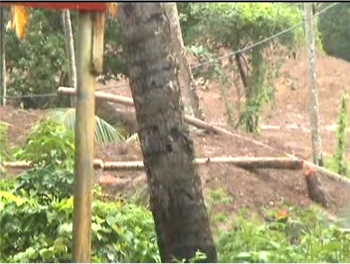
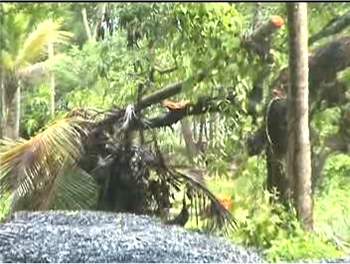
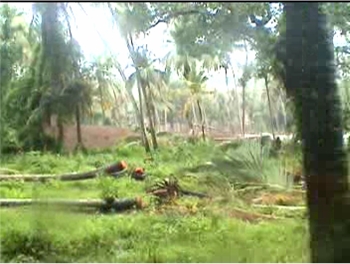
Past few weeks have witnessed cutting down of large number of trees including five thousand coconut trees.


Modus operandi is simple: cut the trees and load it straight it on the trucks and carry it far off. To block the public view of this rape, a five meters tall tarpaulin is used to fence of the land.


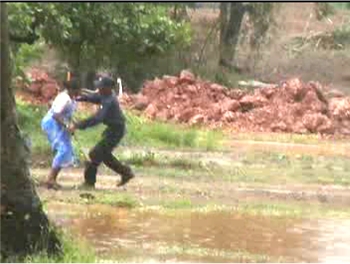
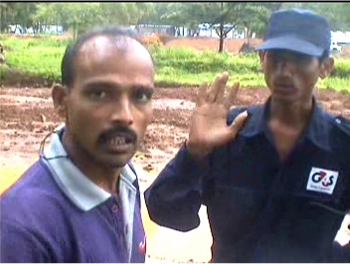
Private security personnel constantly clash with the local villagers including violent confrontations.


The party is the same one that promises Paradise and heaven in nearby Nauxi village to filthy rich from the rest of India, and locals are subjected to goonda pressure every time they speak out.

Goons are brought in hundreds, some times. Even the former central minister's names are linked to this.

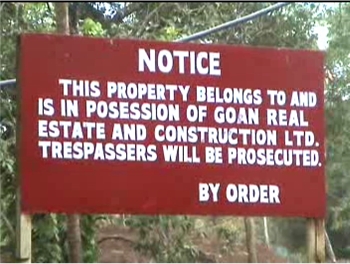
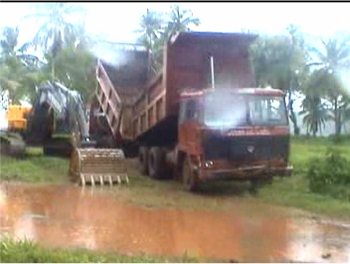
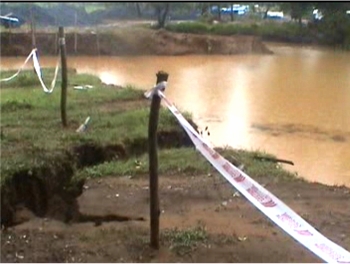
In Bambolim, nexus between power centres of the Goa State and beyond is clear. Police team visits the site twice a day to supervise the ecological disasters. Drinking well is threatened, beautiful pond is buried, plain lands are dug for underground, hills are mercilessly cut down. State administrative machinery, legislature, politicians, police, judiciary, have all been actively siding with the brutal rape of nature and its people's life and livelihood.

The questions arise as to what is going be the fate of Goa's nature and its people?

In the face of failure of the State to defend who is going to stand in defence?

These questions bothers us a lot.

Tell us what you feel and think about this.